Luca de Cilladi, Conservation Intern (2025-26), UCC Library
When I first encountered Ledger 440, I thought what a plain repetitive book of names and numbers. But this seemingly plain volume had a significant problem. The ledger barely opened, limiting access for readers and placing strain on the structure whenever it was consulted. I could almost hear a slight creaking sound on opening, a subtle but telling sign of internal tension.
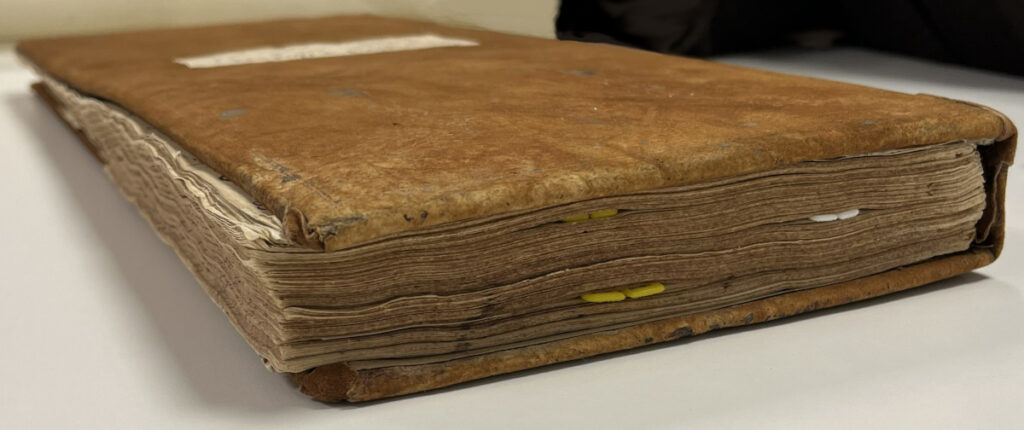
The condition of the ledger told a visually complex story. The brown leather cover was stained and torn showing a long history of use, damage, and intervention. Inside the pages were creases, folds, adhesive residues, broken sewing threads, trimmed pages, and old repairs. I then noticed that the whole book was distorted and that the pages protruded past the edges of the boards. But why?
Before I could begin any conservation treatment, I first needed to examine the ledger closely, understand its structure, and identify the causes of its restricted opening. But to develop the most appropriate conservation and access plan, I needed to uncover a hidden complexity in the spine.
Ledger 440 – shaped by use and time
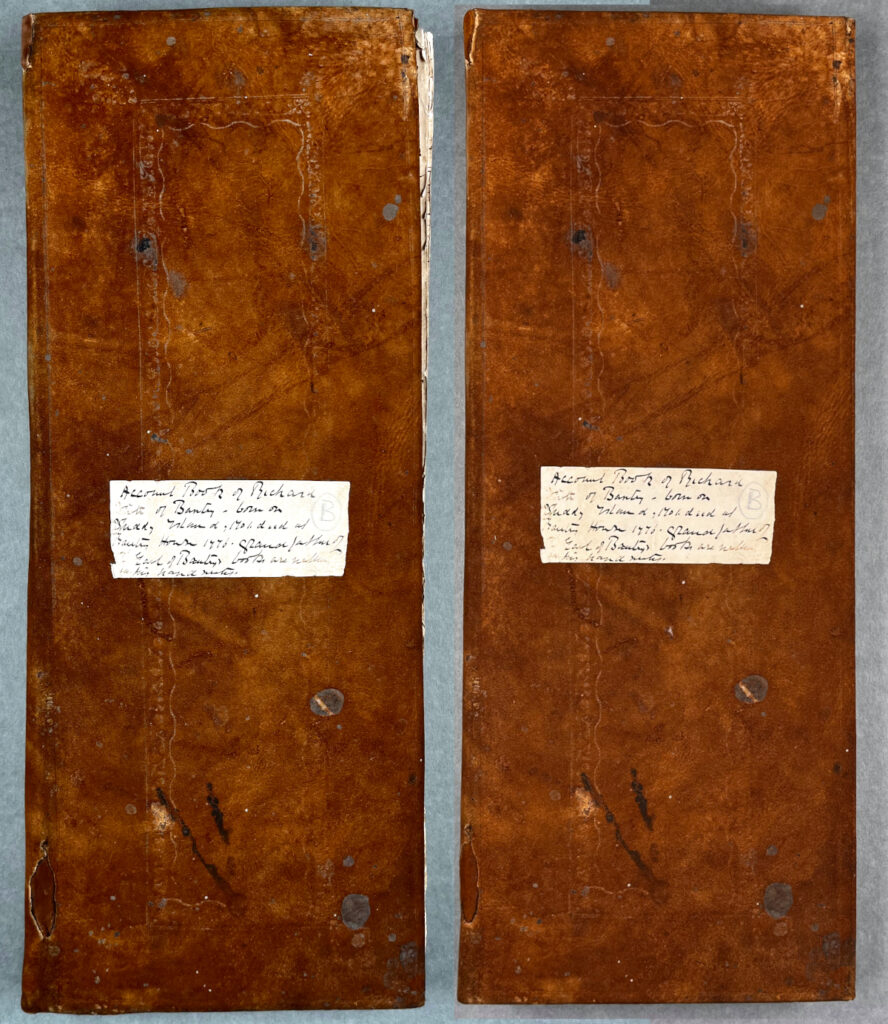
Ledger 440 is an 18th century rental book from the Bantry Estate Collection, donated to UCC Library by Egerton and Brigitta Shelswell-White in 1997. As recorded on the front board label, it belonged to Richard White ‘Councillor White’ (1701-1776), who used the book to record rental payments, tenancy agreements and estate management practices between 1755 and 1765. On page 10, he records he wishes to live in Blackrock House (now Bantry House) while he managed the estate.
“…this farm would set for upwards of £56, but I think no lease ought to be made thereof least any of my family should live at Blackrock, in which Case that farm would be a most convenient Domain”
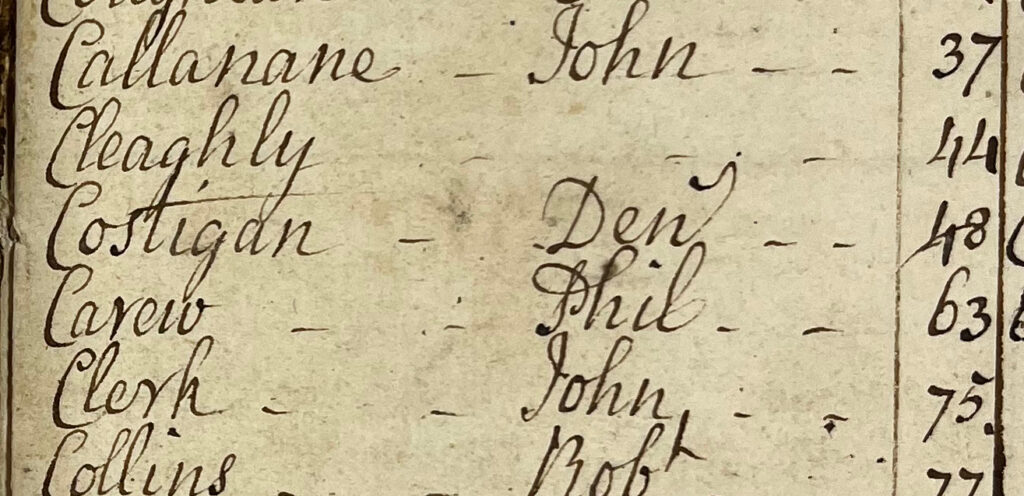
Looking through the ledger, I quickly realised that its focus was not the landowner, but the tenants. An index at the front listed the names of people who had lived on the estate almost three centuries ago. What I had first dismissed as a volume of figures and financial records suddenly became something much more personal: a book about people. Each tenant was assigned a page where rents and payments were recorded throughout the years. What I particularly liked was that many of these entries were acknowledged by the tenants themselves, often using a simple X mark instead of a written signature, indicating their level of literacy.
Value and meaning
In discussing the ledger with colleagues, I soon realised that its condition was only part of the reason it had been prioritised for treatment from the large archival collections in UCC Library. Ledger 440 is a rare record of the everyday lives of people whose experiences are often only faintly represented in the historical record. Documents such as this allow us to trace patterns of tenancy, the continuity of family names, recurring agreements, and changing economic relationships over time, revealing how individuals and families were connected to wider social and economic structures.
Its value extends beyond the study of estate management and local history. The ledger is also an important resource for genealogists and those interested in family and community histories or biographical sociology, offering glimpses into the lives of named individuals across generations. Given its historical significance and rich research potential, ensuring safe access to the volume was an especially important conservation priority.
Ledger 440 is also direct evidence of how estates were managed in the 18th century. Its narrow, elongated format (48.1 x 18.6cm) suggests it was designed to be carried around, possibly in a coat pocket or satchel, and consulted regularly. Inside the volume, there are many corrections, annotations to the original entries, along with many added paper slips. These reveal a process of returning to the book, revising, reflecting, and making decisions over time. Such traces of everyday working life are as valuable as the information itself, preserving a record not only of what was written, but how it was created and used nearly three centuries ago.
Deciding on conservation treatment
Following my initial condition assessment, I was still puzzled by how Ledger 440 was not opening properly. To understand original binding structures, I searched the published literature on 18th century Irish ledgers but found no recent comparable case-studies and few detailed descriptions of this type of commercial bookbinding. I therefore began looking for answers elsewhere. I examined similar ledgers and account books within UCC Library’s collections and travelled to Dublin to study comparable examples in person held at the National Library of Ireland. At the same time, I sought advice from more experienced conservators, including Louise O’Connor (UCC Library) and Dr John Gillis (Trinity College Dublin), on the binding structure and possible treatments.
This research helped me better understand how ledger bindings are designed to open flat and I concluded that later alterations had changed the opening behaviour of Ledger 440. After much deliberation, we decided to separate the text block from the cover to directly see the condition of the spine. I found that it had been repaired using with a modern paper and covered with a thick layer of synthetic adhesive, most likely polyvinyl acetate (PVAc). Rebacking and reinforcing the spine are common conservation procedures, but the use of large quantities of PVAc-like adhesives is now generally avoided. When the PVAc is applied in thick layers, it forms a plastic-like film and this restricted the ability of the spine of Ledger 440 to flex open like its original design. Moreover, long-term aging studies have showni that some PVAc adhesive films lose flexibility over time, which may be further restricting the spine opening.
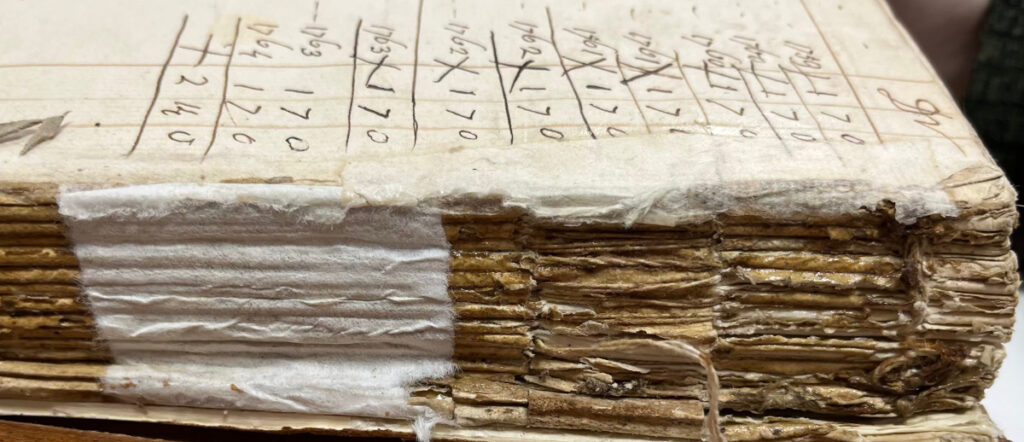
This raised a key question: how should I intervene in a way that restores functionality without compromising the historical integrity of the object. Although a minimal intervention, like repairing the broken sewing threads and extending the sewing supports would improve some issues, the thick layer of adhesive prevented access to the spine folds. Removing the adhesive along the spine became the central challenge of the conservation treatment as restoring the flexibility of the binding was essential.
Conservation Treatment
However, the task was not straightforward. While I could use moisture to soften the adhesive, this posed a risk to the original ink, made from iron galls and highly sensitive to moisture. The challenge was therefore for me to remove the adhesive while avoiding contact with the ink. After a series of tests, I decided that the most effective approach combined localised controlled applications of warm water and heat, to soften the adhesive and then I mechanically removed the glue from the spine.
What I expected to find beneath the synthetic adhesive was the original paper. However, hidden beneath the PVAc was a second dark orange adhesive, probably part of the original eighteenth-century binding, when the glue was applied warm to the spine. This had penetrated deeply into the paper, turned orange on ageing, and now visibly stained the spine folds.
This meant that removing the modern repair was only part of the solution. To reduce the older residues, the book had to be taken apart and each leaf treated individually. The process required attention and patience, allowing the adhesives to be removed gradually while limiting stress on the paper…though certainly not on the conservator.
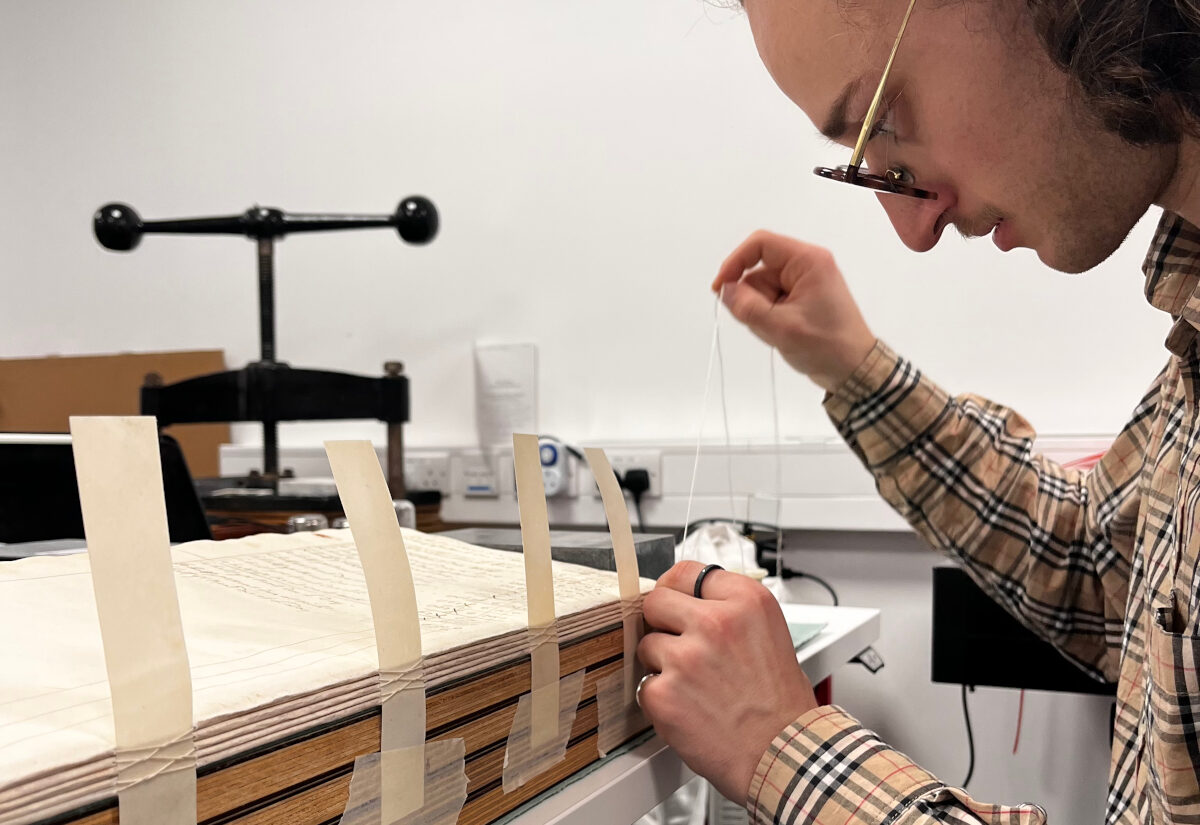
Once the adhesive residues were reduced, I repaired paper tears and areas of loss, reinforced weakened folds, and sewed the ledger following its original sewing pattern. The reverse calf leather cover was then cleaned, repaired, and attached to the text block and new boards.
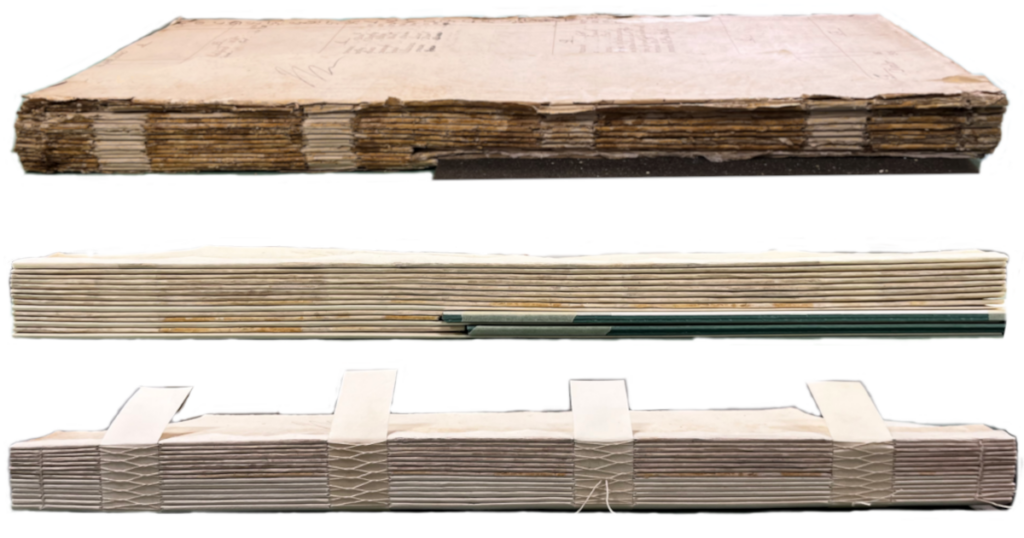
Following conservation, the ledger is now stable and available for researchers to consult, ensuring continued access to an important record while preserving evidence of its history, use, and manufacture. The treatment of Ledger 440 demonstrated that conservation is rarely a straightforward process. It is not about applying a single solution, but about asking questions, exploring possibilities, and adapting approaches as new evidence comes to light. Throughout the project, my aim was to deepen my understanding of the ledger while preserving as much of its historical and structural evidence as possible, and ultimately to improve its stability and accessibility.

iDown, J.L., The evaluation of selected poly(vinyl acetate) and acrylic adhesives: A final research update, in Studies in Conservation vol.60 no.1, Canadian Conservation Institute, Ottawa, Canada, 2015, pp. 33-54.
Luca de Cilladi is UCC Library’s first conservation intern, an intiative co-funded by the Heritage Council and University College Cork Library. Luca specialises in the conservation of paper-based and photographic materials, books, and works of art on paper. He holds a Master’s degree in Conservation and Restoration of Cultural Heritage and has experience working with archival and historical collections. His interests include material history and the ways conservation can help make cultural heritage more accessible.
