On Location
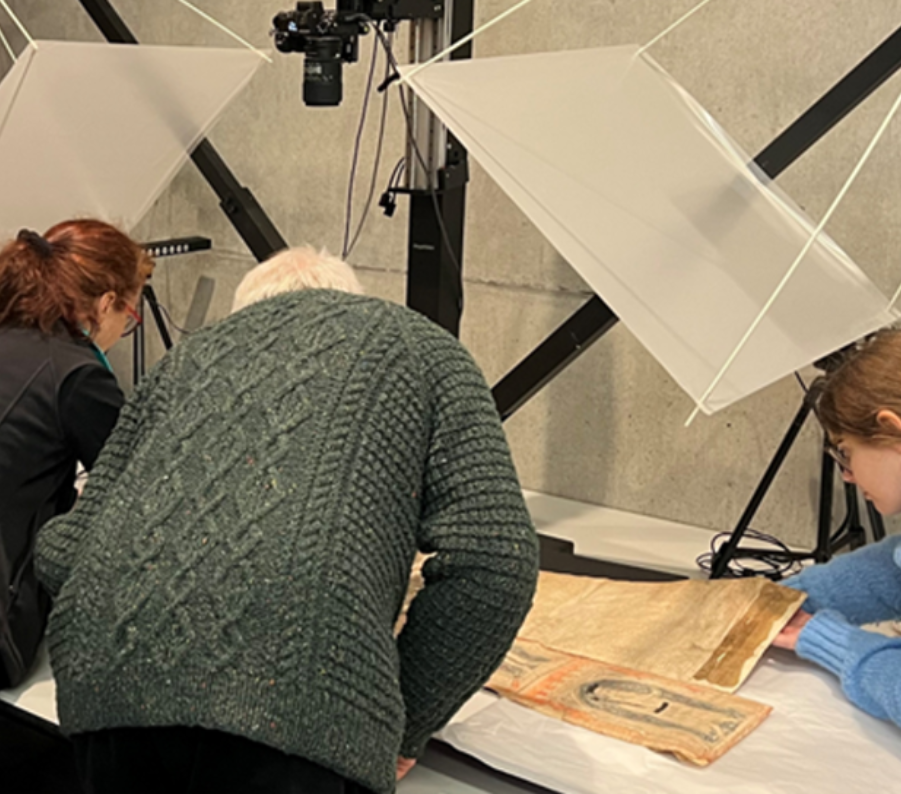
We are currently writing from the Preservation and Conservation Department at the Library of Trinity College Dublin, where we are halfway through a two-week stint of a multi-spectral imaging trip. This is our second time at Trinity College Dublin, the first being exactly a year ago in September 2025, where we took a full set of images of the 12th century Book of Leinster. Our target this time is a manuscript from a few centuries later, the 15th century Yellow Book of Lecan. It is an exciting moment for us as researchers to be able to access these manuscripts which are such important materials of cultural significance, and to begin to enrich our understanding of the materiality of these objects using scientific techniques.
What is Multi-spectral Imaging?
A fair enough question if you are unfamiliar with the technique. Cast your mind back to secondary school science and you may recall learning about the various wavelengths of light, ranging from the ultraviolet (UV), then to visible light (that we can see) and then going into the infrared (IR).

With multi-spectral imaging (MSI), we are taking images of each page of a manuscript across the whole range of these wavelengths, rather than only in the visible range. Each image is taken under monochrome lights at a fixed wavelength or colour. With our main light panels, placed above the object for uniform illumination, we encompass 17 different wavelengths, starting at 365nm in the UV, and ending in 940nm in the IR. In addition to these main lights, we also take 4 images in raking light, coming in at a side angle, as well as 4 other additional lights taken from below, called transmissive light. In total this allows us to take 25 images for any given page of a manuscript, as well as produce a high-definition full color image.
Here you may still be asking yourself, so what? Well, with a regular digital image you are relegated to what you are able to see with the naked eye. When we move beyond the visible light, we are able to see how the inks, pigments and features of the page fluoresce and interact differently with the various wavelengths. For example, iron gall ink will disappear in the IR image whereas carbon based inks will remain visible, allowing for better identification of which materials were used. In other cases we are able to highlight features of the production process we would not otherwise be able to see, such as heavy scrapes marks used in the dehairing and defleshing stage of parchment production.
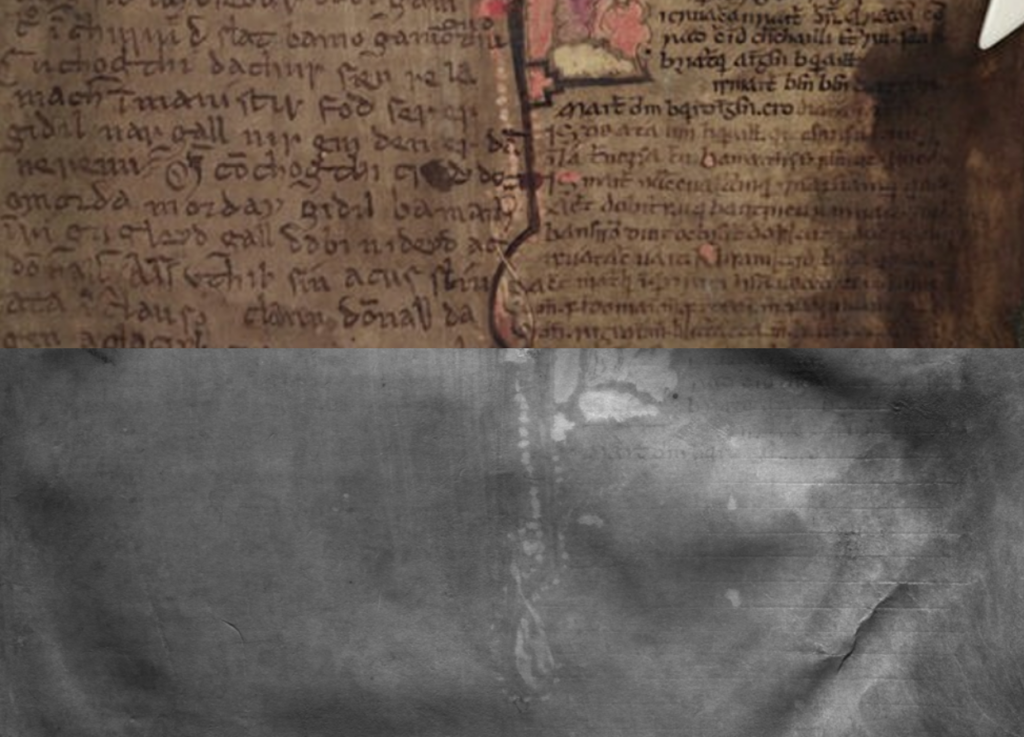
Very importantly for textual scholars, MSI is also able to highlight and recover text in areas where it has become degraded or stained and is no longer legible with the naked eye.
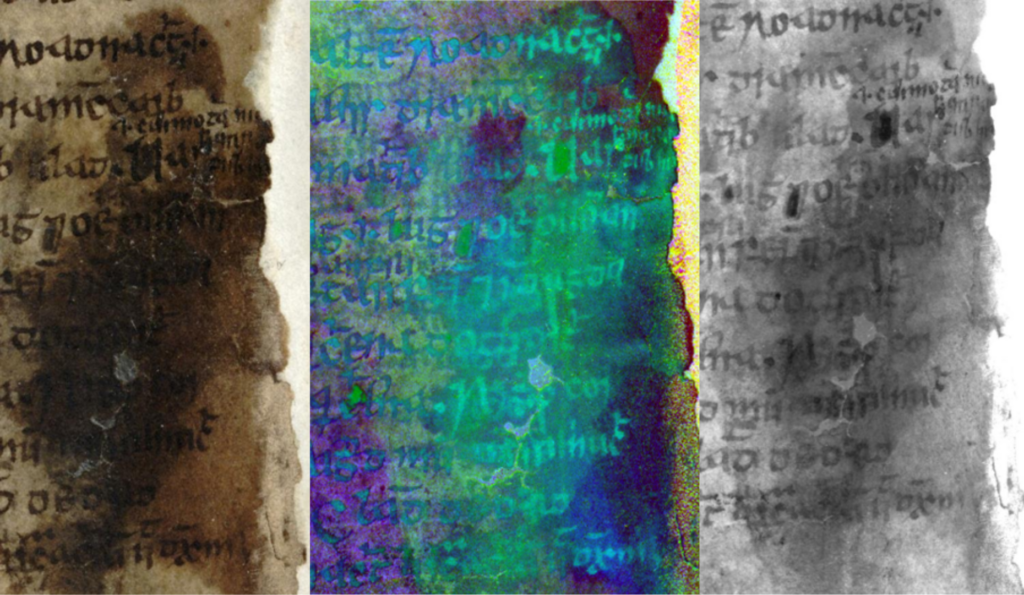
We mainly use MSI on vellum manuscripts for our project, McCarthy MSI, but the same technique can be applied to a variety of other materials and artifacts. We have been testing our system’s capabilities on paper manuscripts, drawings, contemporary material and even coins!
MSI in Practice
We acquired a bespoke MSI system in 2024, through the generous support of Brian McCarthy and Fexco, and under the leadership of Professor Pádraig Ó Macháin of UCC’s Modern Irish Department. This was a continuation of the Inks & Skins Project (2019-2024), which utilized X-Ray Fluorescent Spectroscopy as the main scientific technique to analyze the elemental composition of inorganic elements present in the inks, pigments, and parchment of the manuscripts. Both projects have been supported immensely by our collaboration with the Preservation Directorate of the Library of Congress, in particular Dr. Fenella France and Meghan Hill. Fenella and Meghan have been personally invaluable to us in our own professional development, and have dutifully tutored us in these techniques which has allowed us to embark on imaging sessions on our own.
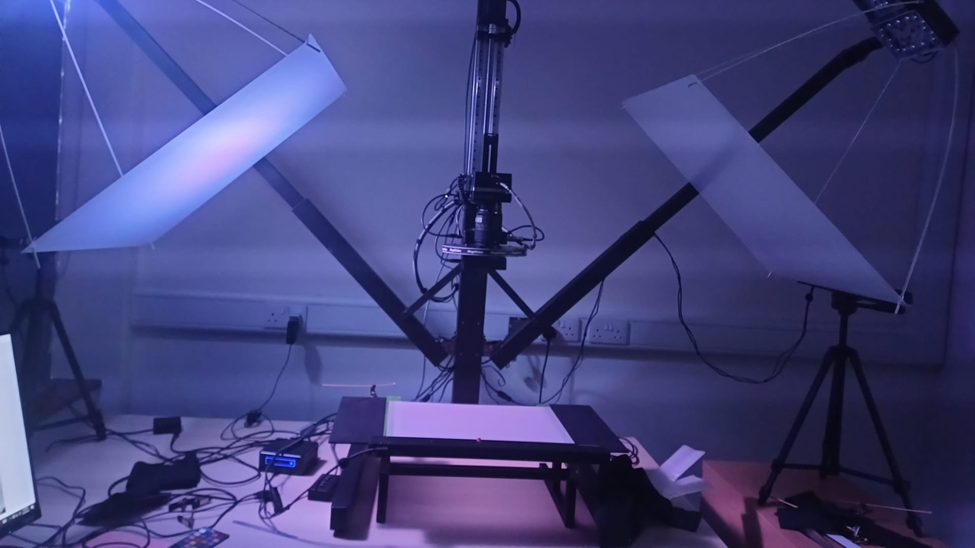
Since starting McCarthy MSI, we have fully imaged 20 manuscripts over multiple imaging sessions, typically each lasting 1-2 weeks. While it is an exciting process and a true joy to be able to have close-up access to these manuscripts, much of our time imaging is spent in total darkness except for the flashing lights of the imaging sequence, which generally takes about a minute and a half per page. For a large manuscript like the Yellow Book of Lecan, our current endeavour, this also means trying to work as quickly and smoothly as possible to ensure we’re able to capture the entire manuscript during our trip. We have certainly honed our process over the last couple of years to have it timed like a dance.
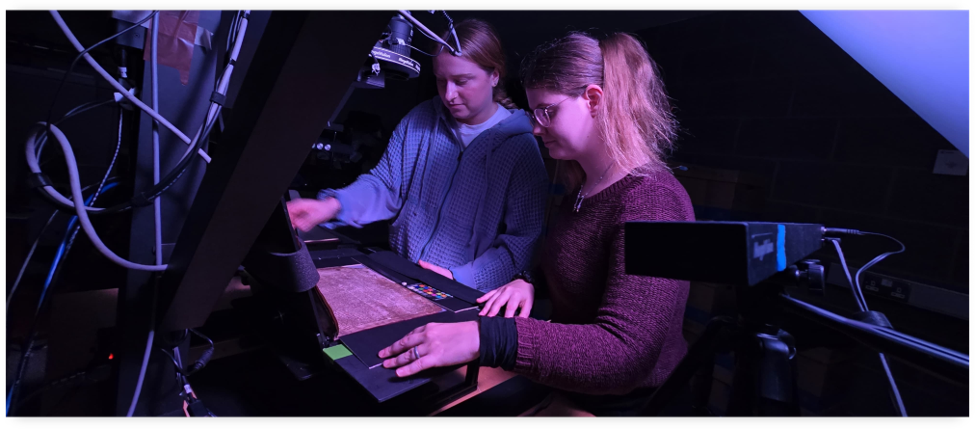
Working with these vellum manuscripts can prove particularly tricky depending on the state they are in. We have been making our way through the 15th century Book of Lecan, held in the Library of the Royal Irish Academy (RIA), which has 311 extant leaves, meaning over 600 image captures. The sheer size and volume of this book, combined with a rather tight binding, means having to take more time with each turn of the page to position it correctly in the camera’s field of view. The majority of our work so far has been in the RIA, as a continuation of our extensive work on their collection of medieval manuscripts with Inks & Skins, hoping to utilise these various techniques in conjunction with one another to create an enriched understanding of the materials of Ireland’s manuscript heritage.
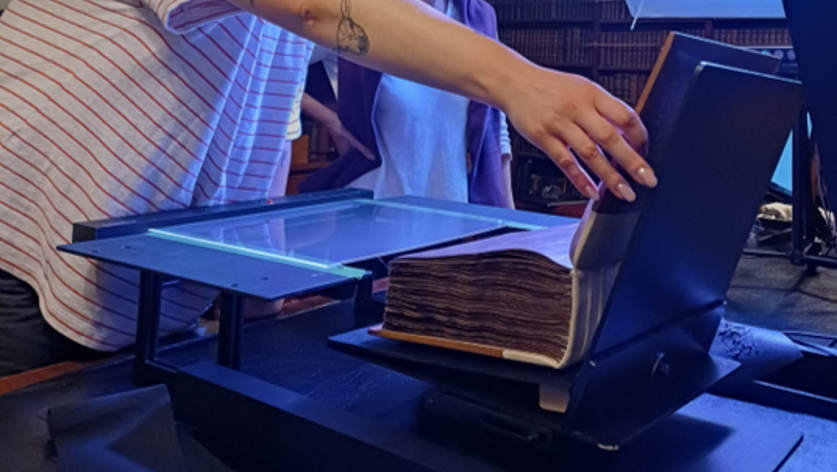
In comparison, our work on the Book of Leinster was made much easier due to the fact that it isn’t bound and was therefore a simpler task to ensure proper placement for each image. This is the same with our current imaging of the Yellow Book of Lecan, due to the work of conservator Dr. John Gillis, based at TCD, who had disbound this manuscript prior to us imaging, and as a part of his conservation work on the book. Not only did this make our process smoother, but it also allowed us to image farther into the gutter of the book, in areas that would not have been able to be seen with the previous binding.
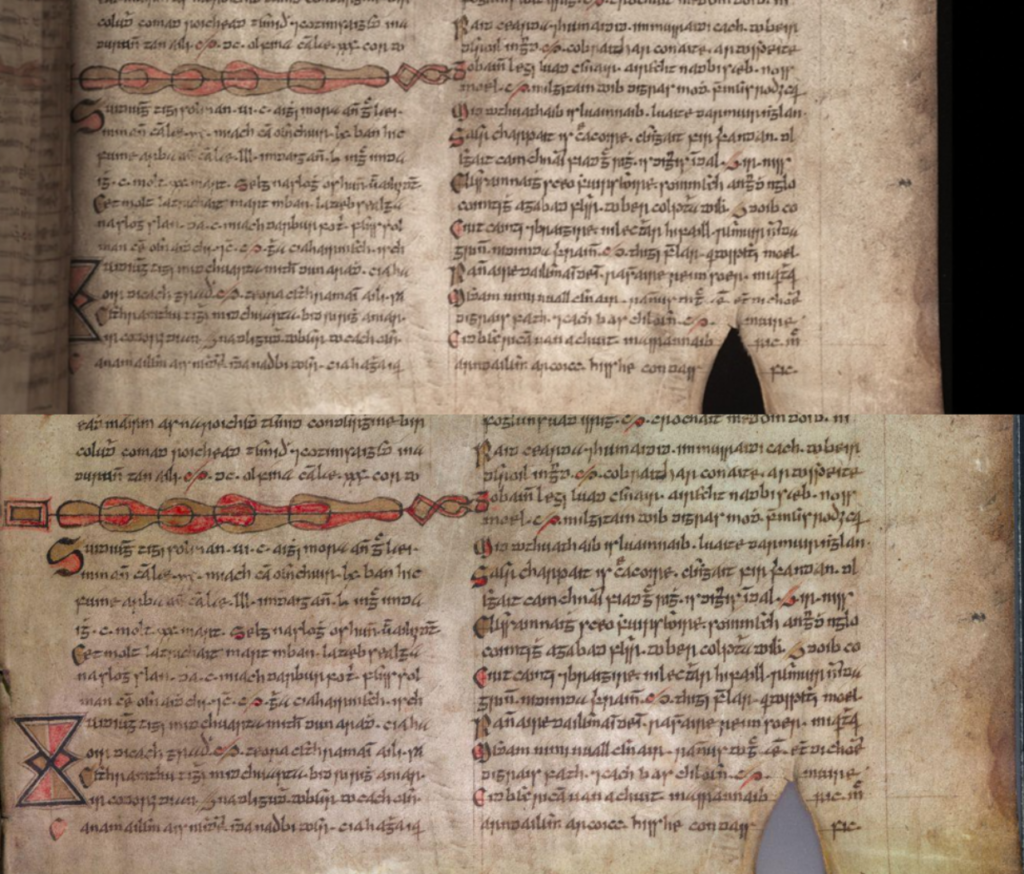
Of course, all the information we gather during our campaigns can only be useful if shared with the research community: the end goal of this project is to make all of our data accessible to researchers and scholars. We are still in the process of figuring out a protocol and platform to share our images, but we hope they will soon be available to anyone who might benefit from our work and we are eager to see how they will help other researchers.
About the Authors
Anna Hoffmann is the Research Support Officer for the McCarthy MSI Project and carries on her PhD research as an Irish Research Council Laureate Scholar from the previous Inks & Skins Project. Her focus is on materiality and scribal practices in Ireland’s late-medieval Gaelic manuscripts.
Ginevra Marchetti is a PhD student at UCC and part of the McCarthy MSI Project team. Her research focuses on the evolution of repair and conservation practices on Irish vellum manuscripts. She holds a Master’s Degree in Conservation of Cultural Heritage, specialising in paper, parchment, leather, photographic and film material.
Acknowledgements
This blog post is part of the public programming for Recording the Past: The Annals of Inisfallen and the Making of Irish History, Glucksman 2 September – 1 November 2026.
With thanks to our partners: The Bodleian Libraries, University of Oxford; National Museum of Ireland; National Parks and Wildlife Service; National Monuments Service; Fexco and Brian McCarthy; Kerry County Council; private philanthropy from Cork University Foundation and UCC’s President’s Strategic Fund.
