UCC Special Collections and Archives: Using special collections and databases to illuminate postwar healthcare treatment
- January 26, 2026
Written by Dr Aisling Shalvey, Marie-Sklodowska-Curie Research Fellow
Short bio about the author
Aisling Shalvey is a MSCA fellow in UCC, working on her project Unaccompanied Children’s Access to Healthcare, from 1945-1950. She looks at the British, French and American occupation zones to examine how healthcare access differed, and tries to expand upon the individual’s lived experience. This Holocaust Memorial Day, Aisling highlights some of the material in the UCC Library Special Collections and Archives and databases that have been helpful in her work.
First to the finding aid: exploring the Peters collection
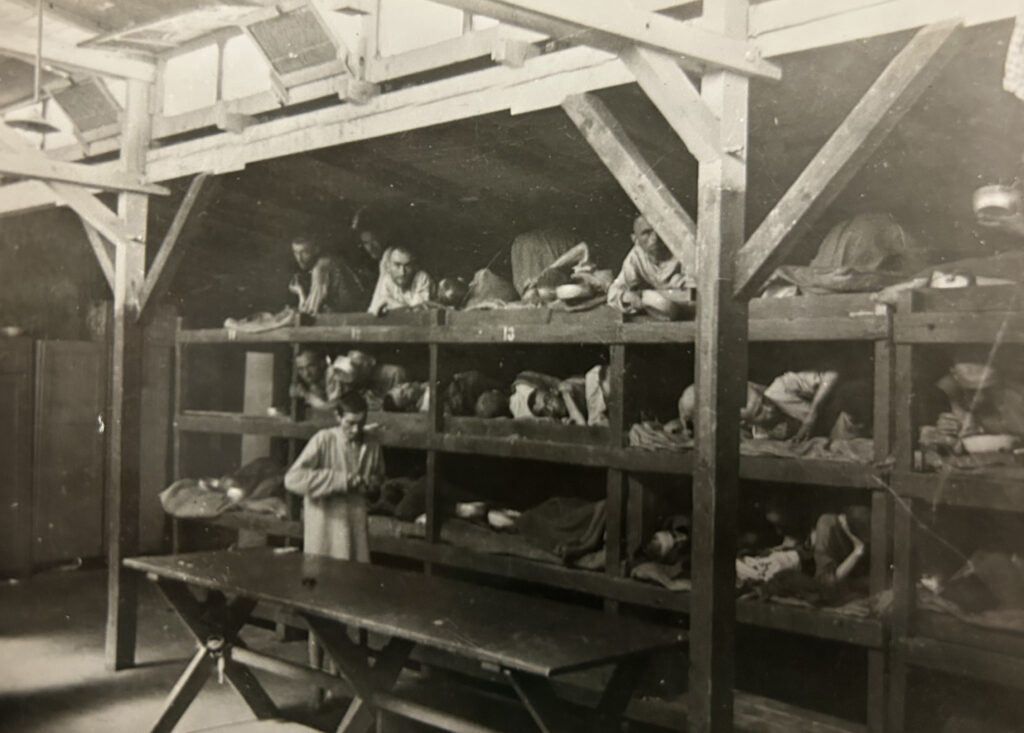
In the finding aid the photograph is listed as ‘interior shot of concentration camp hospital dormitory,’ although it is nothing like any hospital I would recognise. Indeed, without the description on the back of the photograph, there would be no way to know this was a hospital. There are rows upon rows of beds, stacked three high, tightly packed next to each other. Each bed has multiple people, trying and failing to gather some comfort in the dingy surroundings. We see a long table in the middle of the room, and some people eating from enamel bowls in their beds. The table lies empty, an indication on how weak these patients are. One person stands at the table, supporting themselves against it, wearing clothes that are several sizes too big. Some people stare at the camera, others avert their eyes. This scene is from the Peters collection in the UCC Library, a collection of photographs and documents from Major C.M.D. Peters (then Captain) who was a Supply Officer with the American First Army, and was part of the group who liberated Buchenwald in 1945. This collection is a truly unique collection in Ireland, providing valuable insight to the immediate postwar era, and illuminating the scale of the challenges faced by those who had survived the Holocaust. Although this collection is mostly images, captured by the gaze of the soldiers that liberated the camps, we can use another UCC database, the Fortunoff video archive, alongside the wide variety of secondary reference material to help illuminate how the survivors perceived this experience.
Describing the Peters Collection in context
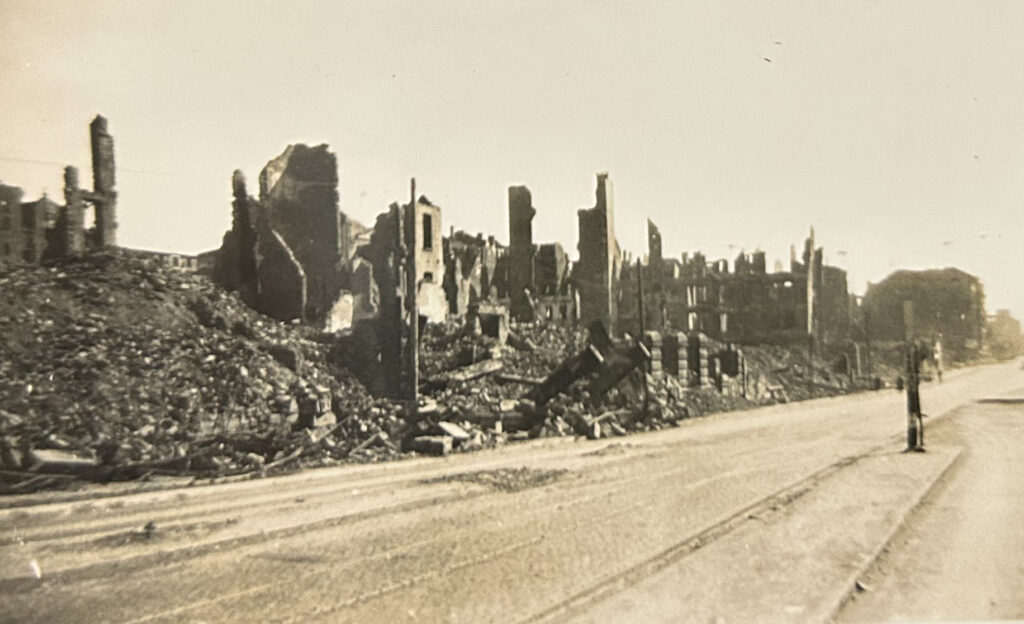
The Peters collection is a captivating collection which includes images of the sheer quantity of destruction in the aftermath of war. Some poignant photographs of the US army discovering the desolation are described in the finding aid in a very apt manner: ‘panoramic streetscape showing the utter destruction of buildings along a main street in a European city. The buildings are mostly reduced to rubble.’ As the collection unfolds the physical destruction gives way to showing the liberation of Buchenwald. There are photographs of piles of corpses, but also those showing the strength of human spirit. One example is that of an effigy of Hitler which is burned. Although the image of the hospital is the only picture of its kind in the collection, it can attest to the postwar reconstruction and the difficulties experienced by those who survived. The description provided on the back of the image of the hospital states that ‘the ambulatory care for those in the cribs,’ illustrating that immediate care for the survivors was often improvised. The extent of the damage done and the levels of medical care that were needed were often astounding, and was documented by Dorothy Macardle, an Irish writer. Macardle, when writing about this experience in her 1949 book entitled Children of Europe stated:
‘In some countries research on the physical deterioration of children is already advanced, the loss of weight and growth in the different age groups has been analysed and the incidence of tuberculosis and other diseases of malnutrition have been plotted on graphs. But there are other injuries which are imponderable. The hurt to children’s mental health and growth and nervous balance to their faith in life and their natural feelings cannot be estimated. Doctors and psychiatrists who work among them if you ask how deep the harm that has yet been done gives everywhere the same answer – it is too early yet to say. In 10 years time more will be known. All we know at present is that there are thousands upon thousands of children in Europe in whom desolation and unendurable memories are hardening into cynicism or despair and that all that is being done to help them is not a hundredth part of what is crying out to be done.’
This quote reflects one of my central research questions, that of long lasting impact based on the moment of liberation and the care that was provided. Did individuals have more positive postwar memories, or conversely, have more enduring medical issues into old age, based on what way they were cared for following liberation? Macardle’s estimate that in 10 years time more would be known is rather an understatement, as we are only now beginning to understand the long term consequences.
Unaccompanied Children’s Access to Healthcare
My project, Unaccompanied Children’s Access to Healthcare (1945-1950) examines issues relating to access to healthcare and financial compensation for medical harm done during the Second World War and explores how such practices have shaped ways of understanding care for refugees. It focuses on the life narratives of child survivors of the Holocaust and what impact healthcare following their liberation had on their later life. The project aims to expand knowledge of the complex issues child refugees faced in the immediate aftermath of World War II and will investigate how antisemitism and other forms of racism affected health care. These issues remain relevant today in the light of the resurgence of antisemitism and xenophobia in Europe, as well as the difficulties many refugees and displaced persons have in accessing much needed medical care. The central research question asks: what factors influenced medical care for unaccompanied children in the immediate postwar era, and to what extent did these factors affect the care they received? The use of the UCC Library for secondary research, the special collections for archival material, and the databases have been instrumental in developing a deeper understanding of medical care in the postwar era and how this was experienced.
Photograph Number: 07230 available at USHMM
Fortunoff video archive of Holocaust Testimonies
While examining the Peters collection brings a feeling of closeness to the immediate postwar and the difficulties faced by those who survived and the Army, of which Peters was one of many documentarians, this can be fully understood only when complimented with other sources. The Fortunoff video archive of Holocaust testimonies contains over 4,400 testimonies, on various aspects of the Holocaust. It can be accessed via the UCC online databases and a university login. It began in 1979 as a grassroots volunteer-led project, and was later donated to Yale university. One such example of how the liberation of Buchenwald, and subsequent medical care was perceived is that of Martin S’s testimony. He was interviewed for the Fortunoff video archive of Holocaust Testimonies in 1986. He was born in Poland in 1933, and gave testimony later in life after he survived Buchenwald and postwar pogroms in Poland. Of his entire family, only Martin, his brother and his mother survived the war. He reflected in this testimony about the moment that Peters captured, the moment of liberation in April 1945. Martin stated
‘You walk around and you just say to yourself, is this really happening? It’s a feeling that is elation, but at the same time you say, don’t get carried away, because it might be a letdown… When they finally came in, and you saw the Jeeps roll in, you saw the different uniforms, you realized it’s over. Tremendous, tremendous high. As a matter of fact, I don’t even remember being hungry […] And here we were liberated. Didn’t know what to do with ourselves. Of course, immediately chaplains and welfare type people came in and began talking to us.’
Martin mentioned the complicated feelings that liberation brought, being physically free, but also very dependent and restricted based on medical care that they needed. He remembered the issue of food being a concerning one, as many people died after liberation as they were not used to eating.
‘…that was one of the big things that happened right after the war. You wanted to hold onto life so desperately. I didn’t know why so much then more than– I guess maybe you wanted to have a taste of freedom for at least a little bit. […] And I remember there were doctors in camp, prisoners, kept going around saying don’t eat this. Your bodies can’t take it. I don’t remember whether I paid much heed, but I know I overdid it. Thank God I didn’t die, but oh I was sick. I was deathly sick. Because our systems were not used to it. Now I understand it.’
Martin’s reflections on the moment of the liberation of Buchenwald can help us to understand the postwar impact of the Holocaust on healthcare. In using these two UCC collections in tandem, we can gather a more rounded view of the same event, literally through the camera of Peters, and mediated through the memory of one of the liberated displaced persons.
Methodology and approach in ascertaining the lived experience:
Rather than approaching the history of medical care in the aftermath of the Holocaust solely through statistics and medical records, I draw on life narratives and read them alongside these other forms of archival materials to consider how children’s life experiences were documented or erased in the archive. In understanding these impacts, this research will expand our knowledge about healthcare crises in the past. Historian Beatrix Hoffman argues that healthcare is frequently used as a proxy for the denial of refugee status, so it is central to understanding the experience of the displaced person and their interaction with institutional structures in relation to my project.In the immediate aftermath of the Second World War an estimated 65 million people were displaced. UCARE1945 then will draw on this research to question how the understanding of healthcare needs of the unaccompanied survivors varied over time, from personal testimonies to literature written later. Personal testimonies will be sought that centre on three key points; liberation, hospitalisation, and trauma, to compare occupation zones and ascertain how health outcomes differed.
Conclusion
The materials held in UCC Special Collections and Archives and online databases offer far more than historical reference points, as they allow us to piece together the lived experiences of those who navigated survival and recovery in the postwar years. By reading the Peters Photographic Collection alongside the testimonies preserved in the Fortunoff video archive, we gain a deeper understanding not only of the immense medical challenges that followed liberation, but also of the emotional and psychological complexities that shaped children’s postwar lives. These sources, when combined, illuminate the distance between what was documented at the time and how survivors later understood their own journeys toward healing.
As my research continues, these collections remain central to uncovering how unaccompanied children accessed healthcare, how decisions made by occupying authorities shaped their futures, and how memories of care, or neglect, can impact life trajectories as well as how we interpret the past as historians. On Holocaust Memorial Day, returning to these archival traces reminds us to continue examining how systems of care respond to those who have endured profound trauma. UCC’s collections ensure that these stories can be understood with greater nuance and provide insight for the work of the historian.
