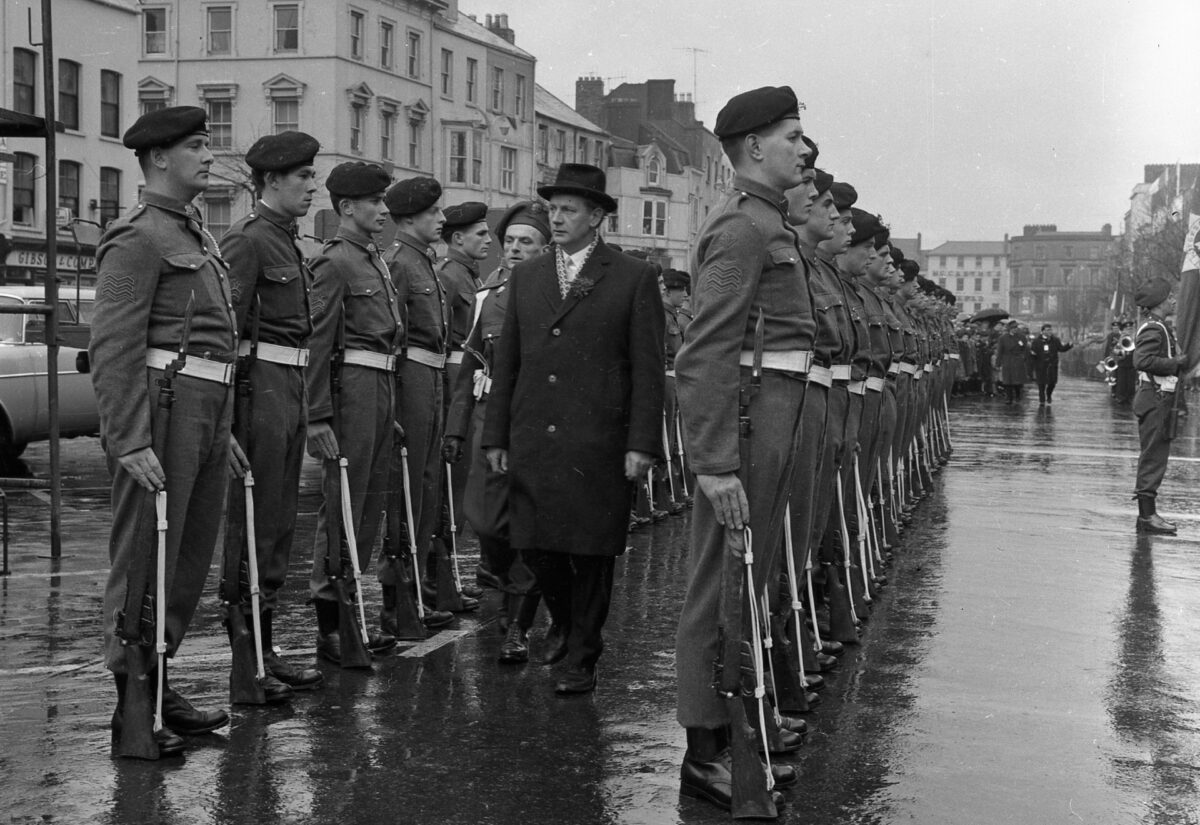
Featured image: Jack Lynch at the St. Patrick’s Day Parade in Cork City, 1965. Photograph by Liam Kennedy. © University College Cork.
Few figures in modern Irish history embody the intersection of public life, cultural identity, and political leadership like Jack Lynch. A celebrated GAA player and twice Taoiseach of Ireland, Lynch’s life bridged local, national, and international spheres.
The Jack Lynch Collection, held in UCC Library’s Special Collections and Archives, offers a remarkable window into that life and into a transformative period in Irish history. Spanning Lynch’s political public career from his early Ministerial roles, his leadership of Fianna Fáil and his years as Taoiseach, the collection captures both the public figure and the wider world in which he operated. It documents a period marked by profound change, including the escalation of conflict in Northern Ireland, Ireland’s accession to the European Economic Community (EEC), and the State’s evolving international role.
Jack Lynch’s Speeches and Appointment Diaries
Since UCC Library’s acquisition of the Jack Lynch Collection, it has attracted sustained interest from both academic researchers and members of the public. Due to its scale, a phased approach to cataloguing has been adopted, with the first phase focusing on a substantial body of Lynch’s speeches and addresses, together with a selection of appointment diaries from the late 1960s to the early 1980s.
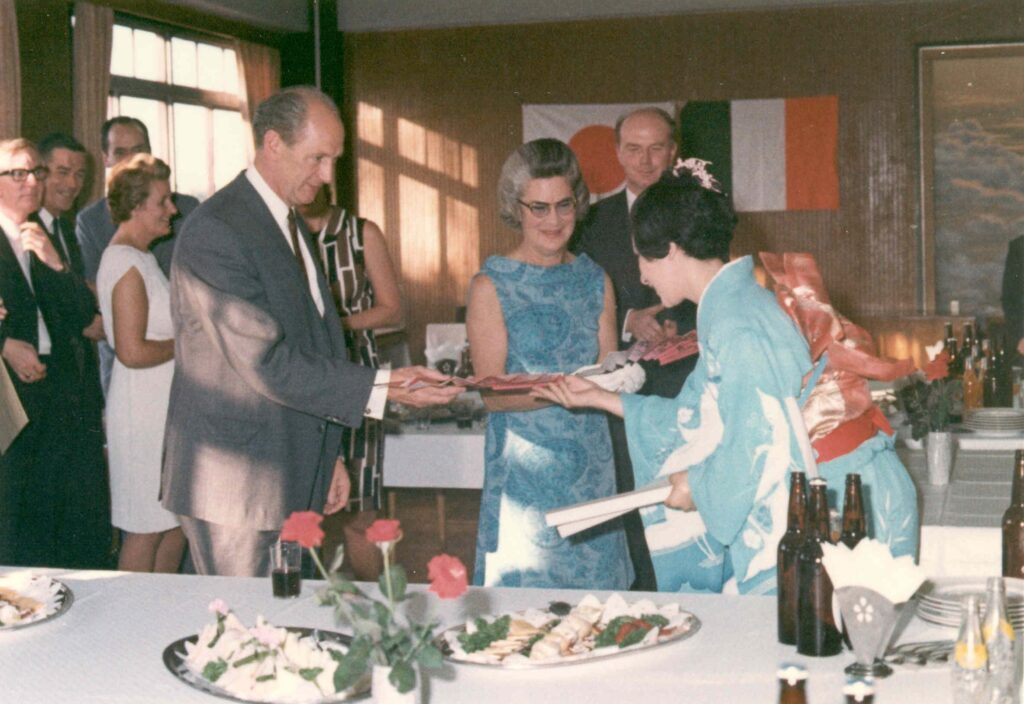
The speeches cover a wide range of contexts, from formal state occasions and international diplomacy to party conferences, local meetings, and public ceremonies. They offer a particularly valuable perspective on how the Irish state presented itself at moments of both crisis and change. Material relating to Northern Ireland captures the immediacy of government responses during the late 1960s and early 1970s, while speeches connected to the EEC referendum and accession process illustrate how political arguments for European integration were framed and communicated. Taken together, this material traces the evolution of policy, rhetoric, and public messaging across one of the most challenging and formative periods in the history of the State.
The entries across the appointment diaries give a glimpse into the daily activities of State such as meetings at Áras an Uachtaráin and with Ambassadors of State. There are entries for Dáil (Parliament) time; Party (Fianna Fáil) meetings; Government meetings; meetings with visiting dignitaries or representatives of business; openings of new buildings and launches of community initiatives or services across Ireland and abroad; as well as formal dinners or receptions of various business and organisations across Irish society across the seven days.
![Softcover Oifig an tSoláthair Dialann [The Stationery Office Diary], for the year 1967, containing details of daily appointments, from the Jack Lynch Collection, UCC Library [IE/BL/PC/JL/1/2/1]](https://theriverside.ucc.ie/wp-content/uploads/2026/05/Fig3b-Appointment-Diary_1-1024x704.jpg)
Archival Listing: Students as Partners
A key element in making this material accessible has been the work of Emily Lucey, MA student in International Relations, who undertook the listing of the speeches as part of her work placement in Special Collections and Archives. Working with approximately thirty files of speeches, Emily created detailed descriptions for each file, recording date ranges, individual speech titles, contextual notes, and the physical extent of the files.
Beyond the immediate output, the project highlights the important role of student placements in archival work, aligning with the Students as Partners programme set out in UCC Library’s Vision and Plan and Student Success in Securing Our Future. By involving students directly in meaningful archival work, rather than viewing them solely as users, the project recognises students as active contributors to knowledge creation and cultural stewardship. In this case, the work has enabled access to the Jack Lynch Collection for use by researchers, students, and the wider public, while demonstrating the value of partnership in shaping both the student learning experience and the development of the Library’s collections.
Fianna Fáil Centenary
The release of the speeches and diaries marks an important step in opening the Jack Lynch Collection to wider audiences. Significantly, this work is being undertaken to coincide with the centenary of the foundation of Fianna Fáil in 1926, providing an opportunity to reassess Lynch’s career and legacy within a longer historical perspective.
As Professor Theresa Reidy, Head of the School of Society, Politics and Ethics at University College Cork, observes:
“Fianna Fáil was the most significant political party in Ireland from its foundation in 1926 until 2011. The party’s electoral dominance is especially evident during the years of Jack Lynch’s leadership of the party. Although Fianna Fáil has lost its dominant electoral position, it retains much of its centrality in governing the state. Interestingly, many of the most significant political issues that dominated Jack Lynch’s tenure as Fianna Fáil leader, such as Northern Ireland and membership of the European Union, remain as important today, as they were in the 1960s and 1970s. Questions about the future constitutional position of Northern Ireland never stray far from the top of the political agenda since Brexit. And on 1 July, a Fianna Fáil Taoiseach, and also a Cork-man, Micheál Martin will take up the Presidency of the Council of the EU on behalf of Ireland. The speeches and papers of the political leaders of the past, in this case, Jack Lynch, hold many insights for the leaders of today, and the leaders of tomorrow.”
In a speech marking the party’s fiftieth anniversary, in 1976, Lynch presents Fianna Fáil as a party rooted in the republican tradition, committed to peaceful political action, responsible for shaping modern Ireland, and still engaged in the ongoing work of national unity and development.
“I had no doubt that as I said in my first Ard Fheis Presidential Address in November 1966, I was inheriting the Leadership of a Party of development, a Party of ideas, a Party which had been and intended to remain in the vanguard of progress in every sphere; the Party which was never satisfied with things as they were and was striving constantly to make them better.”
Speaking at the National Commemoration Ceremony of the 50th Anniversary of Fianna Fáil at the R.D.S. Main Hall, Dublin, 22 May [1976] [IE/BL/PC/JL/1/1/2/3]
The descriptive entries for the speeches and diaries are now publicly viewable on Foinse, UCC Library’s Archives Discovery Platform.
Jack Lynch’s Personal Library
In addition to the archival material, UCC Library also holds Jack Lynch’s personal library. The library complements the archive and comprises books related to the many facets of Jack Lynch’s career: Cork sporting legend, early political career, his time as leader of the Fianna Fáil political party and as Taoiseach.
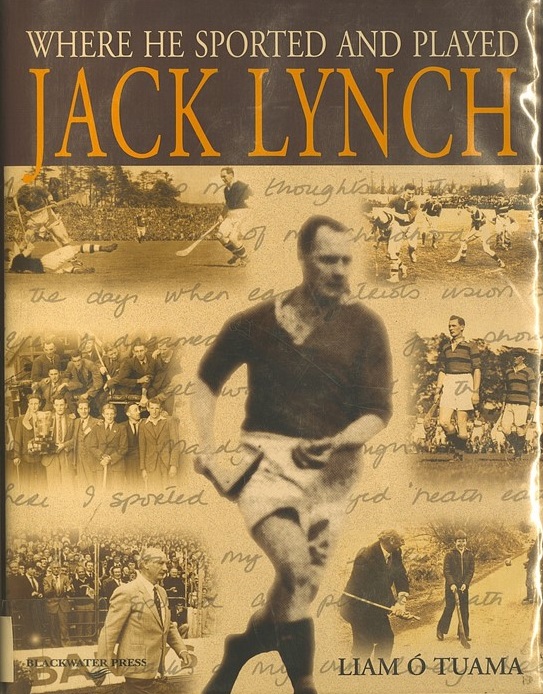
As with the speeches, the printed material reflects the rise in tensions in Northern Ireland, Ireland becoming a member of the EEC and the country’s continuing role in international politics and relations.
